Trading Journal for Prop Firm Traders: A Practical Workflow for Rules, Reviews, and Risk
A practical trading journal workflow for prop firm traders: log rules, review drawdowns, and turn daily notes into consistent risk management habits.
Why Prop Firm Traders Need a Different Journal Workflow
Prop firm trading looks simple on the surface: pass an evaluation, get funded, trade the rules. In practice, the difference between passing and failing usually comes down to behaviors that are hard to see in a brokerage statement. Daily drawdown limits, consistency requirements, and restricted trading windows all sit outside the typical "log my entry and exit" journal format. A general-purpose trade log can record what happened, but it rarely explains why a prop firm challenge went sideways.
That is where a structured trading journal for prop firm traders earns its keep. Instead of treating journaling as a post-trade chore, the workflow treats it as the operating system for the funded account: rules first, trades second, review third. When the journal is wired into the rest of your routine, the same workspace that holds your trades can also hold your daily anchors, your risk checklist, and your weekly review notes.
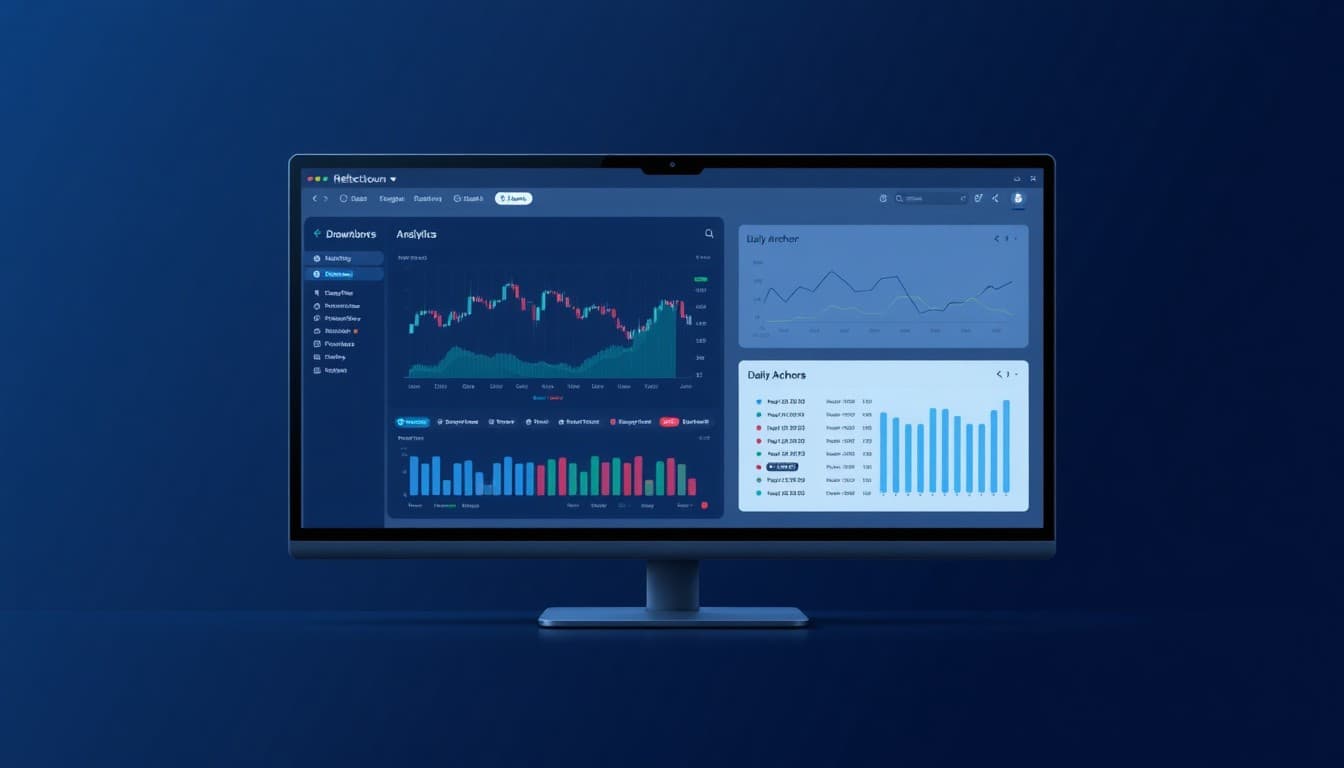
If you are building this kind of setup from scratch, Reflectrade is built around exactly this idea: one workspace where the trading journal, daily anchors, todos, strategies, and performance analytics live side by side. You can start a free trading journal and shape it to match the prop firm rules you are trading under.
The Three Layers of a Prop Firm Journal Workflow
Most journaling setups fail because they only capture one layer: the trade itself. A workflow that survives prop firm evaluations usually has three layers, and each one answers a different question.
Layer 1: Rules and constraints. Before any trade is logged, the firm-specific rules need to be visible. This includes maximum daily drawdown, overall drawdown, profit target, minimum trading days, allowed instruments, and any consistency rules the firm enforces. When these rules live in the same workspace as the journal, you stop relying on memory at the worst possible moment.
Layer 2: The trade log itself. Each entry should record the instrument, direction, size, entry, exit, and the rule context. Was the trade inside the daily loss limit at the moment of entry? Did it violate any session window? Capturing this at the trade level turns the journal from a record into a compliance log.
Layer 3: The review layer. This is where performance analytics and written reflection meet. Equity curve, drawdown progression, win rate by setup, and the notes you wrote during the session are all reviewed together. Without this layer, the journal is just a spreadsheet with feelings.
A workspace like Reflectrade is designed so these three layers do not live in separate apps. The trade screenshots, the daily anchors, and the todos all feed the same review.
Setting Up Daily Anchors for Prop Firm Compliance
Daily anchors are the non-negotiable habits that hold the workflow together. For prop firm traders, they usually fall into a few categories.
Pre-session anchor. Before the market opens or before you place the first order, write down the day's max loss, the remaining drawdown buffer, and the one setup you are allowed to take. This is not a forecast. It is a constraint statement. When the rule is written down, it is much harder to talk yourself out of it three losing trades later.
Mid-session anchor. Prop firm traders often trade across multiple sessions or symbols. A short mid-session note, even two or three lines, captures whether the day is tracking inside the rules. If the buffer is shrinking faster than expected, that note becomes the trigger to stop trading for the day.
Post-session anchor. After the close, the journal entry should answer three questions: Did I stay inside the rules? What was the quality of my decisions, separate from the outcome? What is the one adjustment for tomorrow? This is also where trade screenshots get attached, so the visual context of the chart is preserved alongside the written reflection.
When daily anchors are stored in the same place as the trade log, the review at the end of the week becomes much faster. You are not stitching together notes from a notebook, screenshots from a phone, and fills from a broker. Everything is already in the journal.
Using Todos to Operationalize Prop Firm Rules
Rules are easy to write and hard to follow. Todos close the gap between "I know the rule" and "I actually checked the rule before I clicked."
A practical prop firm todo list is short and repeatable. A typical session might include: confirm remaining daily drawdown buffer, confirm the instrument is on the allowed list, confirm the setup matches the strategy definition, confirm position size against the account's risk parameter, and confirm the session window is open. None of these are exciting. That is the point. The todo list is there to remove the small decisions that drain discipline.
Storing these todos inside the same workspace as the trading journal means the checklist is visible at the moment of execution. If you use a journaling tool that supports daily anchors and todos alongside trades, the workflow becomes a single loop rather than a collection of habits held together by willpower.
Performance Analytics That Actually Match Prop Firm Metrics
Generic performance analytics often optimize for the wrong numbers in a prop firm context. A high win rate can still fail a challenge if the losses are too large relative to the profit target. A strong profit factor can still blow an account if a single oversized trade eats through the daily drawdown buffer.
The metrics that tend to matter most for funded accounts are the ones that map directly onto the firm's rules. Drawdown progression, largest loss relative to the daily limit, distribution of trade sizes, and the consistency of returns across days are usually more informative than headline PnL. Equity curve shape, especially the depth and duration of drawdowns, tells you whether the strategy is compatible with the firm's risk parameters before you hit a rule violation.
When the journal workspace includes performance analytics alongside the written entries, review sessions become more useful. You can see that your drawdown spiked on the days where your notes mentioned "fOMO" or "revenge," and the pattern stops being a feeling and becomes a measurable event. That is the kind of feedback loop that turns journaling from a compliance chore into a real edge-building tool.
Weekly Reviews: Turning Journal Entries Into Prop Firm Progress
The weekly review is where the workflow pays off. Without it, the journal is just a record. With it, the journal becomes a feedback loop.
A simple review structure works well for most prop firm traders. Start with the rules: did any trade come close to a limit, even if it did not breach it? If yes, what was the context? Move to the trades: which setups produced the best risk-adjusted results, and which produced the worst? Then move to the notes: what emotional or contextual patterns showed up more than once? End with one concrete adjustment for the following week, written into the journal so it becomes the next week's first todo.
This is also where strategies come into focus. If a strategy is producing trades that consistently eat into the drawdown buffer, the journal will show it within a few weeks. If a strategy is producing small, consistent gains that align with the firm's consistency rules, the journal will show that too. The point is not to chase a perfect strategy. The point is to make sure the strategy you are running is actually the one your funded account can carry.
Common Mistakes When Journaling for a Prop Firm
A few patterns show up repeatedly in prop firm journal reviews.
Journaling only the winners. Skipping losing trades makes the analytics look better than the strategy deserves. It also hides the trades that are most likely to cause a rule breach.
Treating the journal as a brokerage statement. A fill list is not a journal. The notes, the screenshots, and the rule context are what turn a fill list into something you can actually learn from.
Ignoring the consistency rule. Many prop firms require profits to be distributed across days rather than concentrated in a single session. A journal that only tracks total PnL will not surface this. A review that looks at daily distribution will.
Letting the journal drift. A workflow that is too heavy gets abandoned by week two. A workflow that is too light produces nothing useful. The right setup is the one you will actually run every session, even on the days you do not feel like it.
Building a Workflow You Will Actually Run
The best trading journal for prop firm traders is not the one with the most features. It is the one you will still be using six weeks into a funded account, when the novelty has worn off and the daily grind has set in.
That usually means a small set of habits, supported by a workspace that keeps them visible: rules stored where you can see them, daily anchors written before and after each session, todos that operationalize the rules, trade screenshots attached to the journal entry, and a weekly review that ties it all together. When those pieces live in the same place, the journal stops being a record of what happened and starts being the system that decides what happens next.
If that is the kind of workflow you want to build, you can start a free trading journal and shape it around the prop firm rules you trade under, using Reflectrade as the workspace that holds the whole loop.
Disclaimer
Reflectrade is a journaling and analytics tool, not financial advice. Trading involves risk, and past performance does not guarantee future results.
This article is educational and informational only and is not investment advice. This article is educational and informational only and does not constitute investment advice.