Why Most Traders Fail Without a Trading Journal (And How to Start One)
90% of traders lose money. The difference between the 10% who succeed? They track, review, and learn from every trade. Here's why a trading journal is non-negotiable.
Most traders jump into the markets with a strategy, some capital, and a lot of optimism. Six months later, they're wondering where it all went wrong.
The answer is almost always the same: they never tracked what they were doing.
The Problem No One Talks About
Trading feels like it's about finding the perfect setup. The right indicator. The right entry. But the traders who actually survive long-term will tell you something different — the edge isn't in the setup, it's in the review.
Think about it. Professional athletes watch game tape. Chess players analyze past games. Surgeons review every procedure. But most retail traders? They close a trade and move on to the next one.
That's the gap.
What a Trading Journal Actually Does
A trading journal isn't a spreadsheet where you log entries and exits. That's a trade log — and it's just the starting point.
A real trading journal helps you answer questions like:
- Am I following my own rules? You'd be surprised how often the answer is no.
- Which setups actually make me money? Not which ones feel good — which ones have positive expectancy over 50+ trades.
- When do I make my worst decisions? Is it Mondays? After a losing streak? During high-volatility news events?
- Am I sizing correctly? One oversized position can wipe out weeks of disciplined trading.
You can't answer any of these from memory. Your brain is wired to remember wins and forget losses. A journal forces honesty.
The Compound Effect of Reviewing Trades
Here's what happens when you journal consistently for 3 months:
Month 1: You realize you break your own rules more than you thought. You spot one or two patterns you keep repeating.
Month 2: You start catching yourself before making the same mistakes. Your average loss shrinks because you're cutting losers faster.
Month 3: You have actual data. You know your win rate by setup, your average R:R, your best and worst trading days. You start making decisions based on evidence, not feelings.
This is the compound effect of self-awareness. Each review makes the next trade slightly better.
What to Track in Every Trade
At minimum, log these for every trade:
- Date and time — When you entered and exited
- Symbol and direction — What you traded, long or short
- Setup/strategy — What pattern or signal triggered the trade
- Entry, stop loss, and target — Your plan before entering
- Exit price and P&L — What actually happened
- Screenshots — A chart snapshot at entry tells the full story
- Notes — Your mental state, what you saw, what you'd do differently
The screenshots matter more than you think. A month later, you won't remember what the chart looked like. But a screenshot instantly brings back the full context of why you took the trade.
The Biggest Mistake: Making It Too Complicated
Most traders who try journaling quit within two weeks. The reason? They built a 30-column spreadsheet that takes 10 minutes per trade to fill out.
A good journal should take under 2 minutes per trade. If it's painful, you won't do it. If you won't do it, it's worthless.
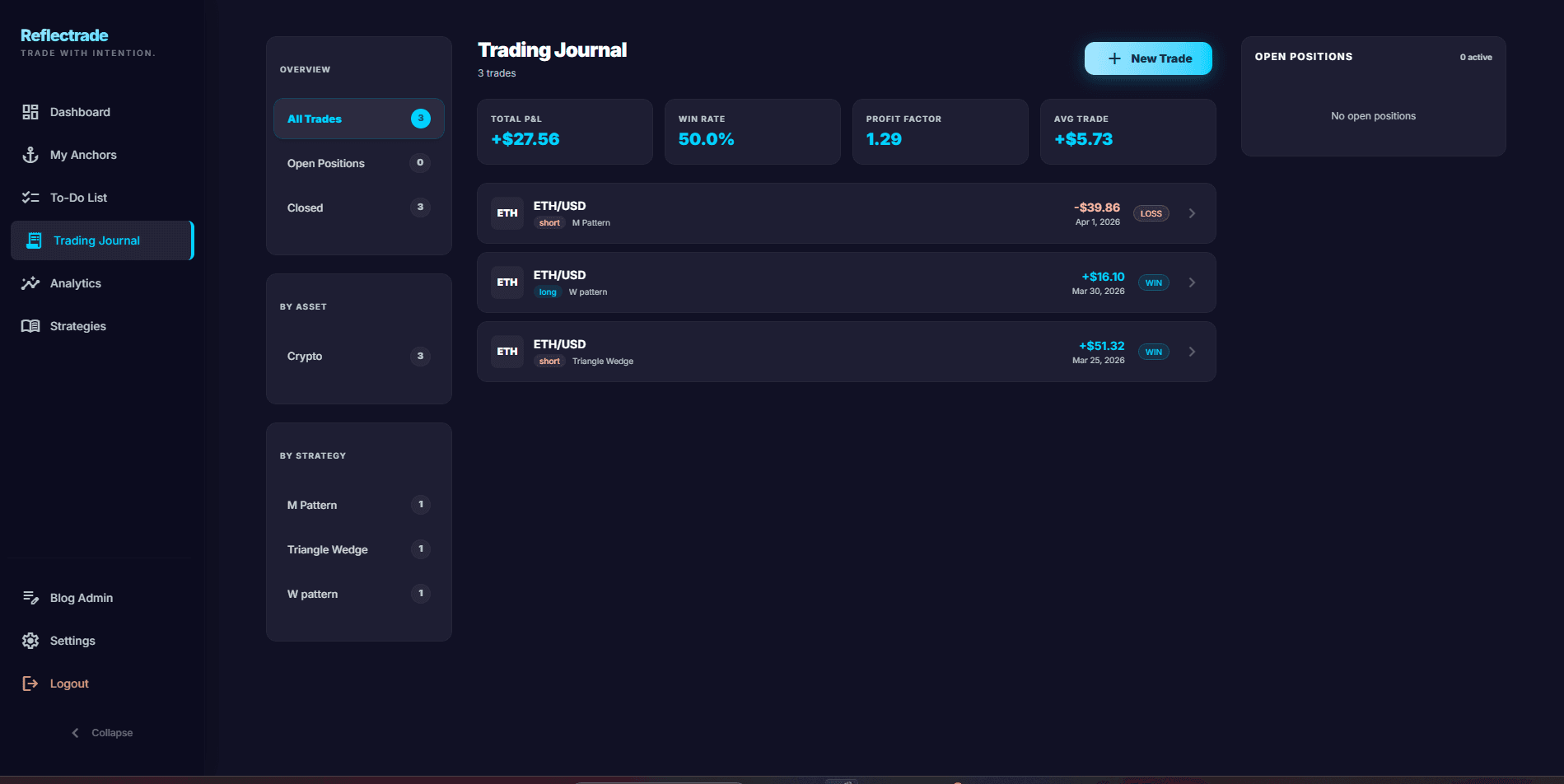
That's actually why we built Reflectrade. We wanted a journal that's fast enough to use after every trade, but powerful enough to surface real insights over time — things like equity curves, win rate breakdowns by strategy, performance heatmaps by day of week, and rule compliance tracking.
But whether you use Reflectrade, a spreadsheet, or a notebook — the important thing is that you start tracking today.
Getting Started: The 5-Minute Setup
If you're starting from scratch, here's the simplest path:
- Pick 2-3 strategies you trade most often. Name them.
- Define your rules for each strategy — entry criteria, stop loss rules, target rules.
- After every trade, log the basics: symbol, direction, strategy, entry/exit, P&L, and one sentence about how you felt.
- Every Friday, spend 15 minutes reviewing your week. Look for patterns.
- Every month, look at your stats. Which strategy is working? Which isn't? Adjust.
That's it. No complex system. No 30 fields. Just consistent, honest tracking.
The Bottom Line
The market doesn't care about your strategy. It doesn't care about your indicators. It cares about execution — and execution improves through review.
A trading journal is the single highest-ROI habit a trader can build. Not because it guarantees profits, but because it guarantees learning. And in a game where most people repeat the same mistakes for years, learning is the real edge.
Start journaling your trades today. Your future self will thank you.